

Manila Bulletin: Asian Cats of Abbas
Asian cats of Abbas
(BARBARA MAE DACANAY)
Monday, October 27, 2008 http://www.mb.com.ph/

The dreamy and colorful cats on the canvasses of Norjan Ismail Alejandro Abbas have unbelievable psychological beauty that they become unforgettable to any viewer. Shown at the Liongoren Gallery in New York, Cubao, from October 15 to 30, his cats emerge as an Asian way of seeing the dusky and feline beauties, with colors more than shapes. “I have been painting cats since 1996. Cats are very interesting. I like cats more than dogs. I have observed them for a long time. When they want something, they arch their back. They are very soft when they move. Their movements are so supple and sensuous,” says Abbas of his favourite subject matter for more than 10 years. “Most cats, from the biggest to the smallest cat, move the same way, with grace. Huge tigers panthers, and jaguars, they seem so light when they move,” Abbas says when asked if his cats are the start of paintings on tigers that symbolize strength more than beauty.
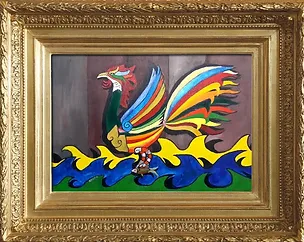
When he makes cats, Abbas begins with half moons and curved shapes. When these shapes mingle and inter-lap in his hands, they naturally give birth to a cat with arched back, or a limpid shape on the floor, or a growling shape with teasing anger on his canvass. When he puts colors on his cats, they float and regain ethereal beauty never seen on any canvass before. What’s the trick? He uses reds, yellows, and blues, which are warm and cool, in geometric shapes. He makes oranges and greens sit together, but he spices them up with violets, creating tension on the canvass. The stripes of his cats have a certain play of geometric lines and colors, as if the cats are canvasses of sensitive abstract geometric paintings. “I use colors to make the eyes of the viewers go all over the painting. I make the eyes move and stop, or dart forward and backward. The colors move and oscillate and the viewers see movements and not a single flat composition on my canvass,” says Abbas. Explaining the value of colors on his canvass, he says, “My colors create the shapes of my cats. In a sense, the color itself becomes the cat. The colors add to the personality of the cat. And the colors of my cats are more Asian than western.” When he was a student at the College of Fine Arts of the university in the Philippines, Abbas started specializing on colors, making them the core of emotions and the heart of expressions on his works.
Despite his arduous studies of color fields and their effects, he says, “Then and now, I combine colors more intuitively than with an aesthetic eye.” “Identity-wise, I consider myself more of an Asian artist than anything else,” says Abbas, when asked if his being a Manila-based Filipino-Muslim has set him apart from other contemporary Philippine artists. Before he did a series on Buddha, he spent five months in Thailand from 2002 to 2003. “I used the sharp curved and pointed shapes of the Thai masks, combined them and made monstrous but colorful shapes on canvass,” he recalls. His has also studied the interplay of colors of the Indonesian masks, how they scintillate with the so-called ethnic Asian flavor. His next plan is to make paintings based on landmarks in Nanjing, with colors more than spaces. He stayed in Shanghai for a year in 2006, teaching children how to draw and paint. No, he does not want his canvasses to be touched by the civil war in Mindanao, the turf of some five million Filipino-Muslims who have been living uneasily with a growing Christian population there. “There is too much seriousness out there. When I make art works, it is not about persons cut in half,” he says, adding, “Intellectually there are many more important things that should be on canvass than politics.” Contact Liongoren Gallery at 9124319 for more inquiries


Comments